Solid wood vs veneer: how to tell, and when it really matters
What veneer is, what solid wood is, five ways to tell them apart in a showroom or from photographs, and what the difference means for repairs, refinishing and the life of a piece.

What veneer is, and what solid wood is
Veneer is a thin slice of wood — usually well under a millimetre to a few millimetres thick — glued onto a core. The core is typically a manufactured board: MDF, particleboard or plywood. What you see and touch is real wood; what carries the load is something else.
Solid wood means the piece is made of wood all the way through. Cut a solid table leg in half and you find the same timber at the centre as on the surface. There is no layer to wear through, because the surface is the material.
Between the two sit a few terms that cause confusion. “Wood effect” or “wood look” usually means a printed foil or laminate, not wood at all. “Engineered wood” is a board product. “Solid wood construction” on a label can mean the frame is solid while the panels are veneered. The only reliable answer is to ask, part by part: what is this made of?
Five ways to tell solid wood from veneer
None of these is conclusive on its own. Together, they rarely leave doubt.
- Look at the edges. On veneer, the edge is often a separate strip, and you may see a fine line where it meets the top. On solid wood the grain on the top continues over the edge.
- Find the end grain. On a solid tabletop the short ends show the growth rings of the wood. On veneered board the end shows a strip, or the uniform texture of MDF or particleboard where it is exposed.
- Follow the grain. In solid wood, a figure on the top — a knot, a dark streak — reappears in the matching place on the side. In veneer, top and side are separate sheets and the pattern does not continue.
- Check the underside and the inside of drawers. Manufacturers rarely veneer what nobody sees. A raw board underneath tells you what the top is made of.
- Feel the weight. Solid wood is not always heavier than board, but a large solid piece has a density you notice when you lift a corner. Very light, very uniform pieces deserve a question.
What it means for repairs, refinishing and lifespan
The practical difference shows up years later. A scratch, a ring from a hot cup, a dent from a dropped key: on solid wood, these can be sanded out and the surface refinished, because there is more of the same wood underneath. A good solid piece can be refinished more than once over its life.
On veneer, sanding has a limit. Go through the top layer and the core appears, and the repair becomes a replacement. Water is the other weakness: if moisture reaches a board core through a damaged edge, the board can swell, and the veneer can lift.
That is not a reason to distrust all veneer. It is a reason to know which one you are buying, and to weigh the price against how long you expect to live with the piece.
When veneer is the right choice
Veneer is not a trick. It has a long and honourable history in cabinetmaking: it allows rare and highly figured woods to be used economically, it makes very large flat panels stable, and on a good substrate, made by a good maker, it can last for generations. Many of the finest pieces of twentieth-century furniture are veneered.
Where veneer struggles is in pieces that take daily wear on their surfaces and edges — dining tables, desks, chairs — and in curved, sculptural forms, where a thin sheet must follow a shape it was not grown in. In those cases solid wood earns its higher price.
Solid teak, piece by piece: how we build
We work in solid wood, mostly teak. Every piece in the current collection is solid teak, in one of three finishes: Light Oak, Antique Oak or Wengé. These are the names of the finishes; the wood underneath is teak. We do not use veneer.
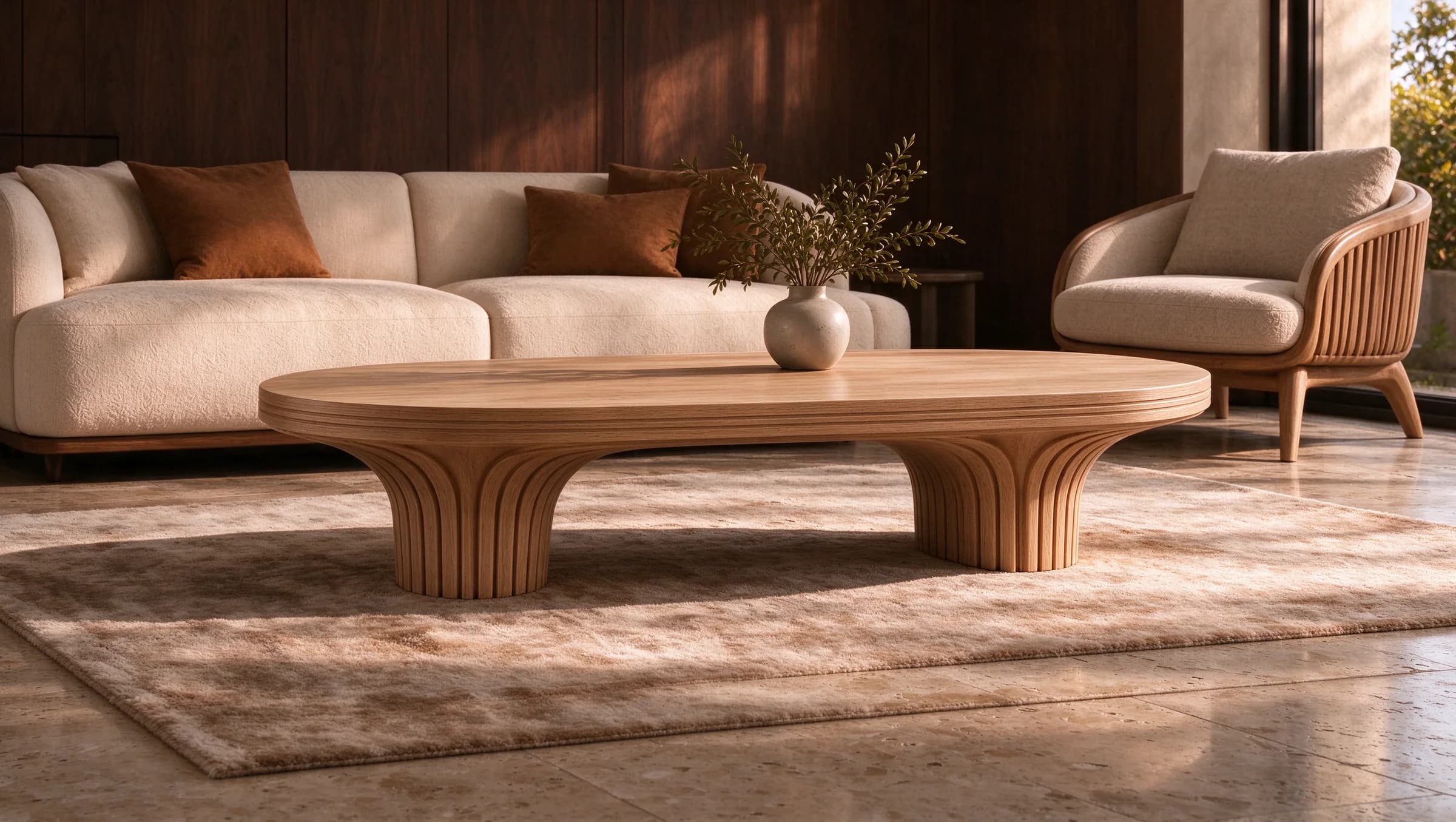
The construction differs per piece, depending on what the design asks. Many of our forms are built up in layers: on the Executive Desk you can count seven of them in the curve that runs from the top down to the floor. Because the layers are solid, the edge you touch is the same wood as the core, and the curve shows the material honestly instead of hiding it.
Teak is a natural choice for this. It is a dense, oily hardwood with a long reputation for stability, it works cleanly, and it takes a finish evenly. The same qualities are why it has been used for centuries where wood has to hold its shape.

What to ask before you buy
In a showroom or on a call, ask three things: what the top, the edges and the base are each made of; whether the piece can be sanded and refinished, and how many times; and what the price includes. A maker who works in solid wood will answer quickly and specifically. If you want to see what that looks like in a finished piece, start with the Dining Table — or read why we think furniture you buy once is the better economy.
Questions
Is solid wood always better than veneer?
No. Good veneer on a stable core, made well, can last a very long time and is the right choice for some pieces. Solid wood is more forgiving of daily wear because it can be sanded and refinished, and it is better suited to curved, sculptural forms.
How can I tell if a dining table is solid wood?
Look at the end grain on the short ends of the top, check whether the grain runs continuously over the edge, and look underneath. A visible edge strip, a uniform board texture or a mismatched pattern between top and side points to veneer.
Can veneer furniture be refinished?
Lightly, sometimes. Because the wood layer is thin, aggressive sanding goes through it. Solid wood can be sanded back and refinished more than once.
Is ALUR furniture solid wood?
Yes. We work in solid wood, mostly teak, and every piece in the collection is solid teak, in the finish you choose (Light Oak, Antique Oak or Wengé). We do not use veneer.
See the piece
Every piece is handmade in our atelier in Bali, in about six weeks, then shipped to your destination.
