Sculptural dining tables: a buyer’s guide to bases, sizes and seating
What makes a dining table sculptural, how the base decides where people can sit, how much length you need per person, and how to choose chairs that let the table lead.
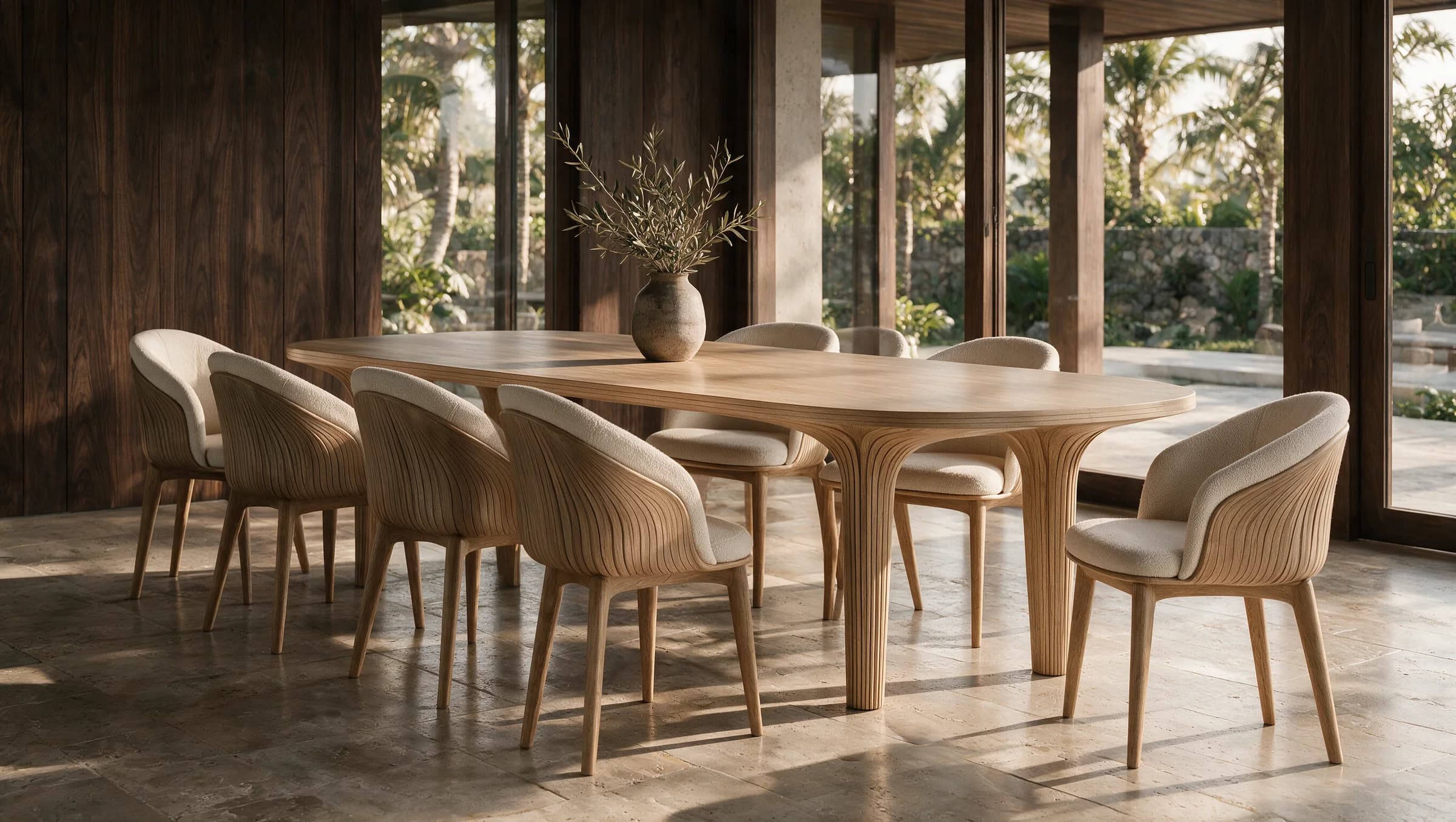
What makes a dining table sculptural
A dining table is the largest flat surface in most homes, and most of it disappears under plates and elbows. What remains visible is the edge and, above all, the base. That is where a table becomes sculptural: when the legs or pedestal are not just supports, but a form that carries the eye from the floor to the top in one movement.
The best sculptural tables keep that movement continuous. The top does not sit on the base like a lid; it grows out of it. Edges are shaped rather than cut square. And the material is shown honestly — solid wood whose grain or layers follow the curve, or stone whose weight reads as calm above a moving form.
Base types: legs, pedestal or sled
The base is the most important decision, because it decides not only how the table looks but where people can sit.
- Four legs at the corners. The most generous for seating: the long sides are entirely free, so chairs can be placed anywhere. Sculptural versions shape and flare the legs so they read as part of the top.
- Pedestal. One or two central columns. Excellent on round and oval tables, where no one sits at a corner. On long rectangular tables, a pedestal needs a wide foot to stay stable, which can take legroom at the ends.
- Sled or trestle. Two frames at the ends, sometimes joined by a stretcher. Strong and graphic, but the frames sit where the end diners’ knees would be, and a stretcher limits how far chairs slide under.
Size and seating: how much table do you need?
A common rule of thumb is 60 cm of table length per person, and more — 65 to 70 cm — if the chairs are wide or have arms, or if you want to dine rather than simply eat. Depth matters as much: below about 90 cm, two place settings and a serving dish in the middle start to compete. A width around 100 to 110 cm is comfortable for sharing plates.
Allow room around the table, too. Chairs need to slide back, and people need to pass behind them. A clearance of around 80 to 100 cm between the table edge and a wall or sideboard is a widely used guide.
Our Dining Table comes in 260 and 300 cm, 110 cm wide and 75 cm high, with its four legs at the corners. Our Dining Chair is 58 cm wide, so we plan around 65 cm per person: at 260 cm, four chairs along each side; at 300 cm, there is room to place them more generously, or to add a chair at each end.
Height and leg clearance
Dining tables are usually between 72 and 76 cm high, and dining chairs have a seat height of around 45 to 47 cm. What matters is the gap between them: roughly 28 to 32 cm from seat to tabletop is generally comfortable. Our table at 75 cm and our chair at a 46 cm seat height leave 29 cm.
Check the underside as well as the top. A deep apron or a thick top reduces the room for thighs. If you are tall, or if the table will also serve as a desk, measure from the seat to the lowest point beneath the top, not to the surface.
Wood, finish and stone
Solid wood is the natural material for a sculptural dining table, because a shaped edge exposes the inside of the material. On veneered board, a curve either shows the core or has to be wrapped. Our guide to solid wood and veneer explains how to tell the difference.
Our table is made of solid teak, built up in layers and shaped into one continuous form, and finished in Light Oak, Antique Oak or Wengé. These are the names of the finishes; the wood is teak in each case. A lighter finish makes a long table feel lighter in a room; the darker Wengé reads as a single dark form.
Stone tops — travertine, marble — suit smaller tables, where their weight stays manageable. Our Restaurant Table pairs a layered wood base with a stone top in round and square sizes, for kitchens, breakfast corners and hospitality.
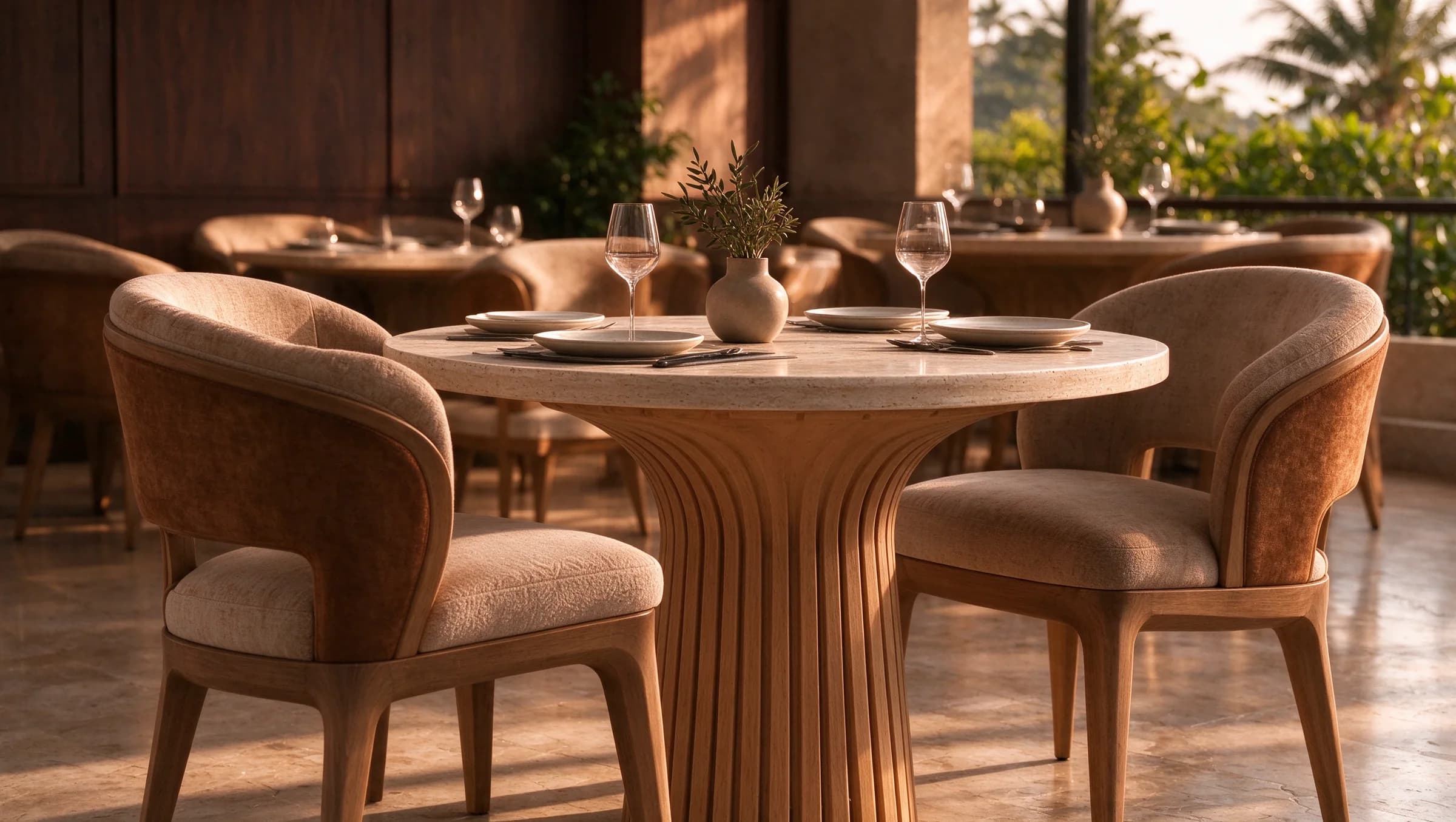
Pairing chairs with a sculptural table
Let one of the two lead. A strongly sculptural table looks best with chairs that are calmer, or that share its language without competing — the same wood and finish, a related curve. Mixing a sculptural table with equally expressive chairs in a different material often makes both look busy.
Upholstery changes the character. A textured bouclé softens a dining room and catches light; leather is cleaner and ages with use. Our Dining Chair is made in the same solid teak as the table, with a choice of leather or bouclé, so the set reads as one family.
Finally, count the chairs you need every day, not the maximum. A table that seats eight comfortably will seat ten for a celebration; one that is always full is too small.
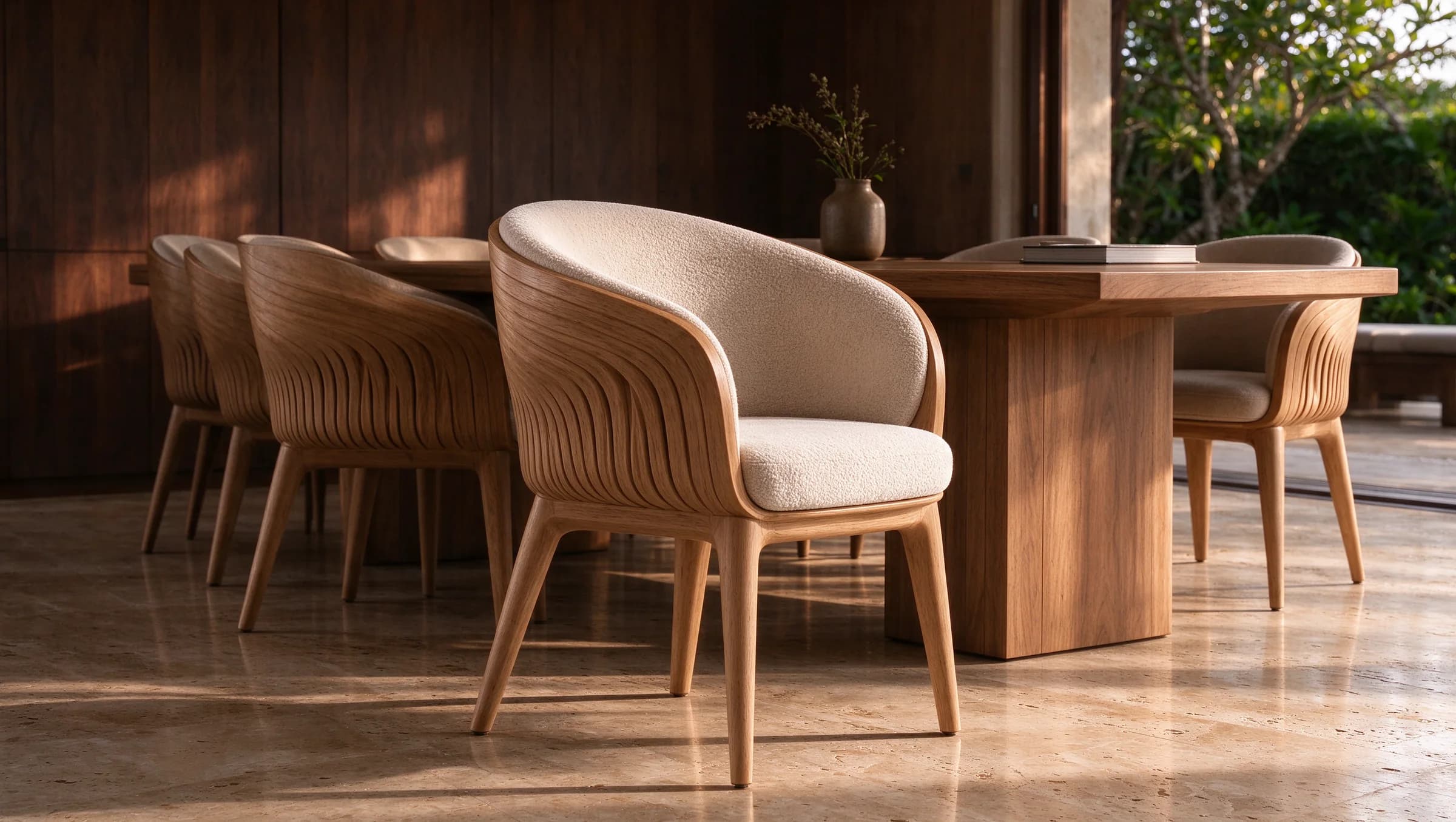
Collection size or made to measure?
If 260 or 300 cm fits your room, the collection table is made by hand in our atelier after your order — about six weeks, then shipping — from €6,900, including VAT; shipping extra. If your room needs a different length or width, that is a custom piece; we talk it through on a call and send a price and lead time before anything is made. More on custom made.
Questions
How many people fit at a 260 cm dining table?
With roughly 65 cm per person, four along each long side — eight in total — and two more at the ends if the base leaves room. Four legs at the corners make this easiest.
Which base is best for a long dining table?
Legs at the corners leave the long sides completely free for chairs. Pedestals work best on round and oval tables; on long tables they need a wide foot.
What is a good height difference between chair and table?
Around 28 to 32 cm between the seat and the tabletop is generally comfortable. Our Dining Table (75 cm) and Dining Chair (46 cm seat) leave 29 cm.
Is teak suitable for an indoor dining table?
Yes. Teak is a dense, stable hardwood that takes daily use well, and as a solid wood it can be sanded and refinished if the surface is damaged.
See the piece
Every piece is handmade in our atelier in Bali, in about six weeks, then shipped to your destination.