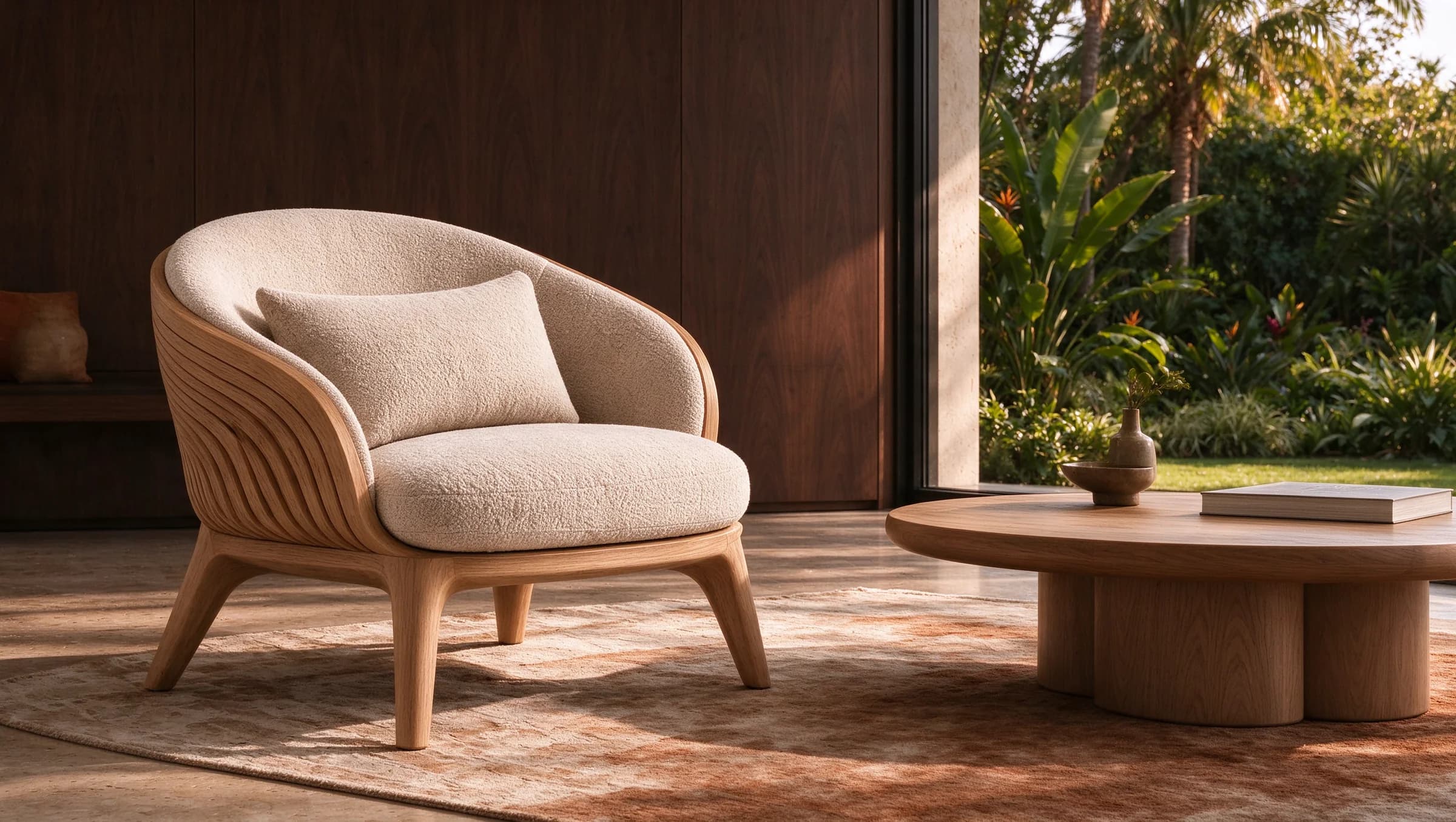
Custom furniture from Bali: how it works and what to check
Why so much wood furniture comes from Indonesia, the difference between an exporter and an atelier, the timber paperwork that exists, and how to judge quality from the other side of the world.

Why Bali and Java became a centre for wood furniture
Indonesia has worked teak for centuries. Java has long-established teak plantations and a deep tradition of woodcarving, and the island of Bali added something else: a design culture shaped by hotels, villas and the architects who came to build them. The result is a dense network of makers — from village workshops to large export factories — within a few hours of each other.
That density is why a search for custom furniture so often leads to Bali. It is also why the experience of buying here varies so widely. The same street can hold a careful atelier and a reseller of mass-produced pieces, and from a website the two can look much the same.
Exporter, middleman or atelier: know who you are buying from
Most furniture that leaves Indonesia passes through one of three kinds of business. It helps to know which one you are talking to before you pay anything.
- An exporter buys from many workshops, consolidates containers and handles paperwork. Good for volume and standard items; the person you speak to rarely knows how your piece is built.
- A middleman or agent sources on your behalf for a fee or a margin. Useful if you have no time to visit, but quality depends entirely on how often they stand in the workshop.
- An atelier designs and makes its own pieces. You talk to the people who design and build the furniture, and a change to a dimension or finish is a conversation, not a chain of emails.
What to ask before you order
Whichever route you choose, a few questions separate a serious maker from a risky one. Ask them in writing and keep the answers.
- Is the piece solid wood throughout, or veneer over a board? Ask how the edges and the end grain look. Our guide to solid teak and veneer explains what to look for.
- What exactly is included in the price — finish, upholstery, packing, insurance, shipping, import duties and VAT?
- How much is the deposit, and when is the balance due: before shipping or on arrival?
- Will you see the piece before it ships? Progress photos and a short video of the finished piece are a reasonable request.
- What documents travel with the wood (see below), and who is the importer of record in your country?
- What happens if a piece arrives damaged — who files the claim, and with whom?
Wood legality: SVLK, FLEGT, EUDR and the Lacey Act
Timber is one of the most regulated materials in international trade, and furniture from Indonesia sits in the middle of it. This is a short, informational overview — not legal advice, and not a statement about any particular supplier.
Indonesia runs its own timber legality assurance system, known as SVLK. Exported wood products carry a legality document under that system, often called a V-Legal document. Indonesia and the European Union have a Voluntary Partnership Agreement under the EU’s FLEGT programme, which is why Indonesian shipments to Europe have travelled with FLEGT licences.
The EU Deforestation Regulation (EUDR) adds due-diligence duties for companies that place wood products, including furniture, on the EU market. Its application date has been postponed more than once, so check the current timetable when you plan a purchase. In the United States, the Lacey Act prohibits trade in illegally harvested wood and requires an import declaration for many wood products.
What this means for you as a buyer: ask which documents your supplier provides and who carries the import obligations. A maker who answers clearly, and can show the paperwork, is worth more than any claim on a website.
Lead times, shipping and import
A piece made to order takes longer than one taken from stock. At ALUR, every collection piece is made by hand in our atelier after your order — about six weeks — and then shipped. Fully custom work adds a design stage before production starts; nothing is built until you have approved the drawing and the finish.
Shipping time depends on the destination and on whether a piece travels by sea or by air. Import duties and VAT depend on your country and on how the goods are classified. Our prices include VAT; within the EU we pay the import duties and VAT, so there is nothing to pay on delivery, and shipping is quoted separately. Whoever you buy from, ask for the full delivered cost to your address before you commit, and plan around it if your project has a fixed opening date.
Judging quality from a distance
You cannot run your hand along a table on the other side of the world. You can come close.
Ask for a video call in the atelier, with the camera on the piece rather than on a showroom. Ask to see the underside, the joints, the edges. Ask for photographs at stages of production — when the form is shaped, when it is sanded, when the finish goes on. A maker who is proud of the work will have no difficulty with any of this.
Finishes are harder to judge on a screen than shapes. If the colour matters — and with wood it usually does — ask for photographs in daylight next to something you know, such as a white sheet of paper.
How ordering works at ALUR
We are a design studio with our own atelier in Bali. We design every piece ourselves, and every piece is made by hand. The collection — from the Dining Table to the Executive Desk — is made in solid wood, mostly teak, never veneer, in the finish you choose. Many pieces, such as the Executive Desk, are built up in layers and shaped into one curve.
A collection piece is paid in full when you order, through the secure checkout or a payment link from the studio; if you have questions first, book a video call. For a different size, a different finish or a piece that does not exist yet, we start with a conversation: you book a call, we talk through the room, and you receive a price, a lead time and the payment terms before anything is made. More about that process on custom made, and about the case for buying once on why custom made.


Questions
Is it safe to buy furniture from Bali?
It can be, if you know who makes the piece and what you are paying for. Ask whether you are dealing with an exporter, an agent or the atelier itself, get the price, deposit and delivery terms in writing, and ask for photographs or a video of your piece before it ships.
How long does furniture from Bali take to arrive?
Production comes first: an ALUR collection piece is made by hand after your order, in about six weeks. Shipping time then depends on the destination and on sea or air freight. Ask for both figures before you order.
Do I pay import duties on furniture from Indonesia?
Usually you pay import VAT, and depending on your country and the classification of the goods there may be duties. The rules differ per country, so ask your supplier who acts as importer and what the delivered price to your address includes. For ALUR pieces delivered within the EU, we pay the import duties and VAT.
Can I see my piece before it is shipped?
With a maker who works in their own atelier, yes — ask for progress photographs and a video of the finished piece. We are happy to show your piece on a call.
Talk it through
A free 20-minute call with the people who design and make the furniture: what fits your room, the finishes, a price and a lead time.